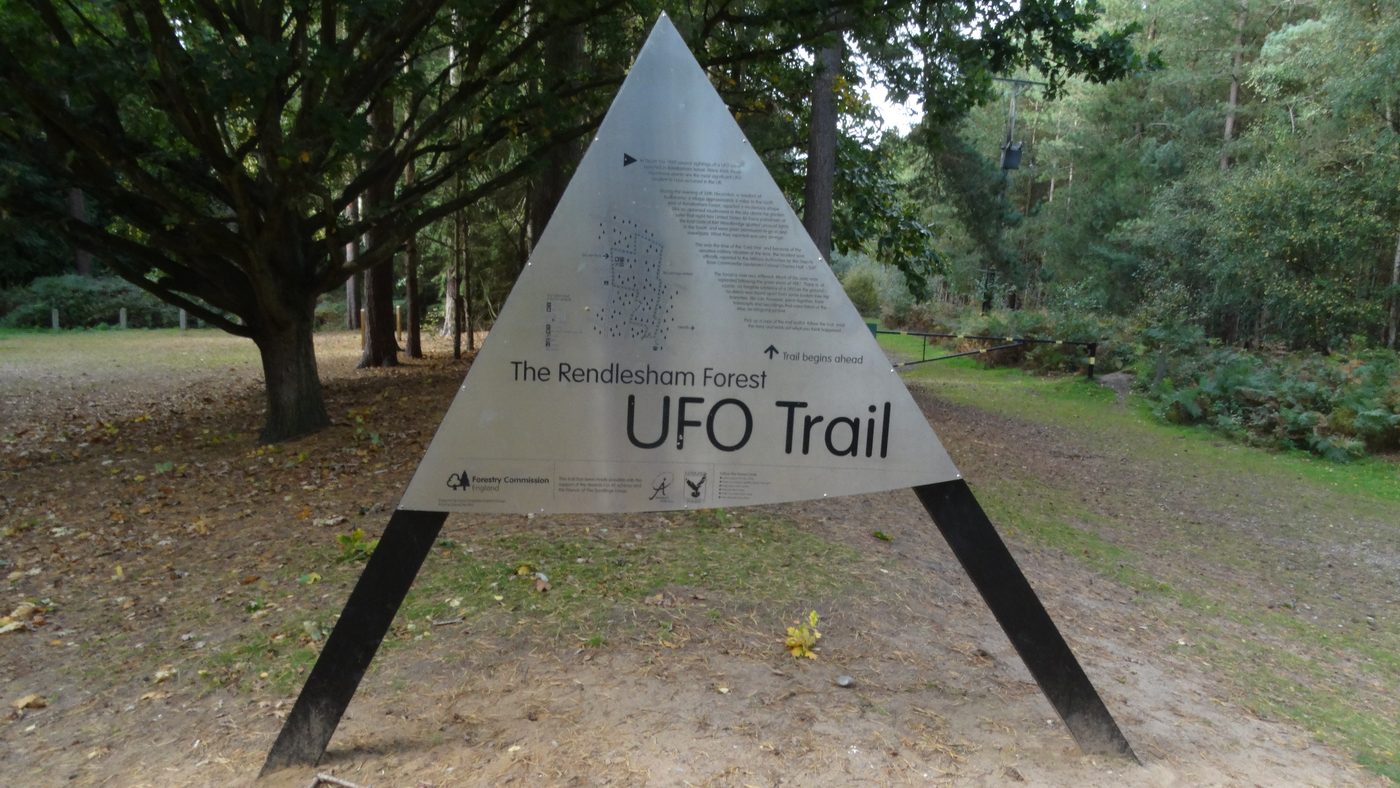
Flight Log
UAP FILES: Navy pilots describe a “Tic-Tac” object outmaneuvering an F/A-18 HEROIC: The co-pilot who landed a 767 with zero engine power over Canada BIZARRE: The flight attendant who survived a 33,000-foot fall. Read the case HISTORY: Inside the deadliest day in aviation: two 747s, one foggy runway SCARY: The cockpit voice recording no pilot forgets UAP FILES: Navy pilots describe a “Tic-Tac” object outmaneuvering an F/A-18 HEROIC: The co-pilot who landed a 767 with zero engine power over Canada BIZARRE: The flight attendant who survived a 33,000-foot fall. Read the case HISTORY: Inside the deadliest day in aviation: two 747s, one foggy runway SCARY: The cockpit voice recording no pilot forgets
Case File · UAP Files · The Halt Tape

THE NIGHT THE US AIR FORCE MET SOMETHING THEY COULDN'T EXPLAIN

Over three nights after Christmas 1980, US Air Force security police stationed at RAF Woodbridge, a NATO base in the Suffolk countryside, reported a craft on the ground in the forest outside their fence. Two nights later, the deputy base commander went out to investigate for himself, carrying a pocket tape recorder to document whatever he found. He came back with eighteen minutes of his own voice describing something moving through the trees. The tape was declassified. You can still listen to it today. It remains the most thoroughly documented military UAP encounter in history, and nobody, in forty-six years, has ever fully explained it.

December 26–28, 1980 Rendlesham Forest, Suffolk, England RAF Woodbridge & RAF Bentwaters 81st Tactical Fighter Wing, USAF
Last reviewed and updated: August 2026
3Nights, Dec 26–28
18:12Length Of The Halt Tape
3Ground Depressions Found
46Years Still Unresolved
Part One

The Base

RAF Woodbridge and RAF Bentwaters sat about a mile and a half apart in the Suffolk countryside, both officially Royal Air Force stations, both leased to the United States Air Force under a NATO basing agreement that had run since the early 1950s. Between them, and wrapping around Woodbridge's eastern perimeter, lay Rendlesham Forest: a dense Forestry Commission pine plantation, planted in tight rows, criss-crossed with sandy byways.

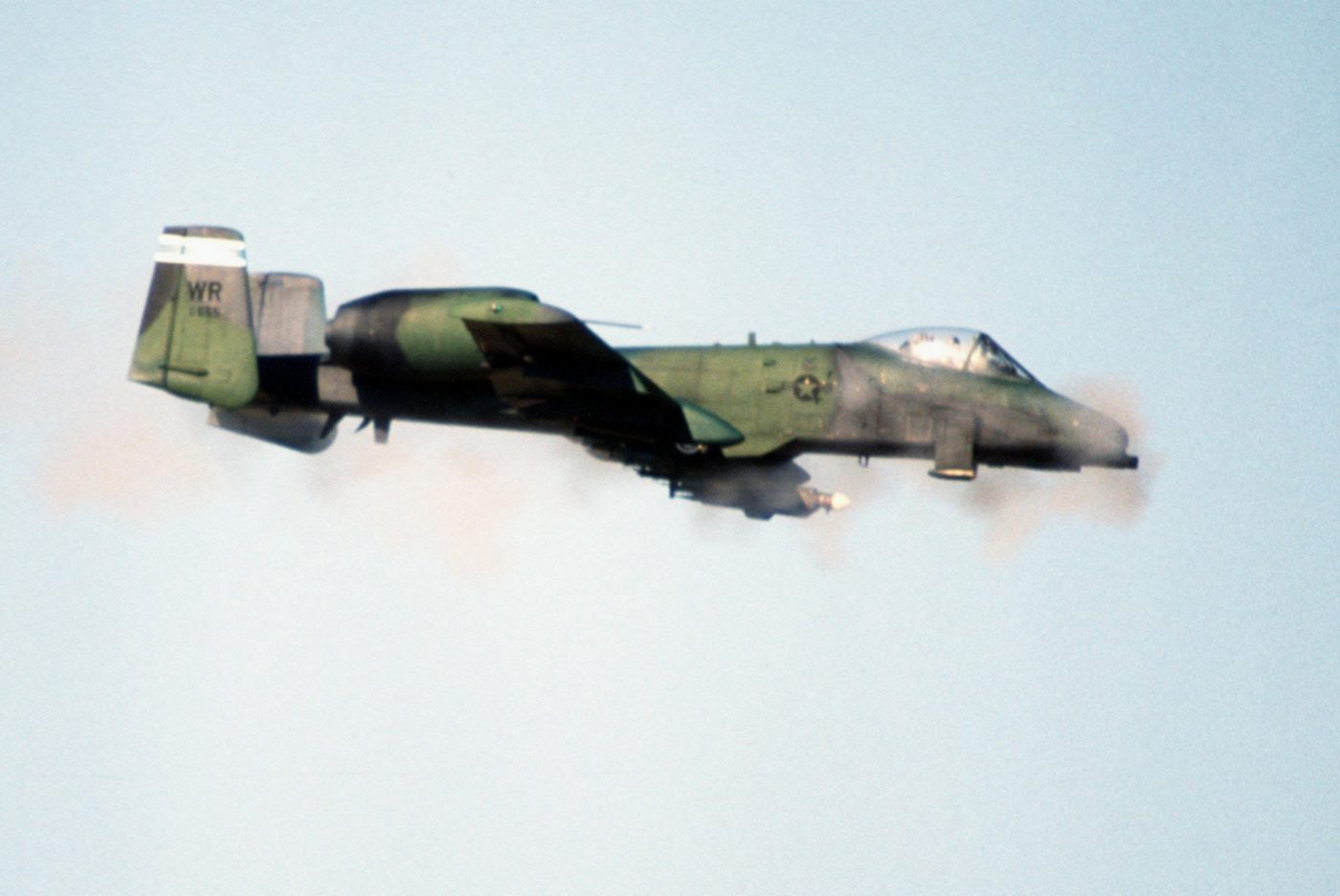
By December 1980, the two bases functioned as a single joint command, home to the 81st Tactical Fighter Wing, a USAF unit flying the A-10 Thunderbolt II in the Cold War's close-air-support and, per persistent and never officially confirmed claims from some former personnel, tactical nuclear storage role. Colonel Gordon E. Williams held overall wing command; Colonel Ted Conrad commanded RAF Woodbridge day to day; Lieutenant Colonel Charles I. Halt served as deputy base commander. The pattern of a military installation declining to elaborate is familiar from the Mantell case. Wing Commander Donald Moreland was the senior Royal Air Force liaison officer on the joint base, the man nominally in charge of the ground the Americans were leasing.

It was a high-security Cold War installation, ringed with fencing and patrolled around the clock by USAF security police, sitting inside an ordinary stretch of English forest that, at the end of December, was also cut through by public byways used by dog walkers and foresters. That overlap, a military base with genuinely alert security patrols backing directly onto a public working forest, is part of what makes what happened next so unusual: it wasn't reported by a single startled witness, but logged, patrolled and eventually tape-recorded by trained personnel doing their jobs.
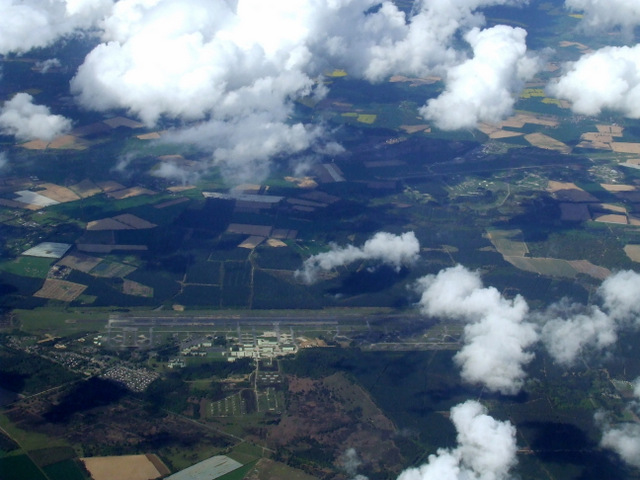
Aerial view of RAF Woodbridge and the former RAF Bentwaters, the twin NATO airbases either side of Rendlesham Forest, Suffolk
Photo: Thomas Nugent via Wikimedia Commons, CC BY-SA 2.0. RAF Woodbridge and the former RAF Bentwaters, seen from the air.
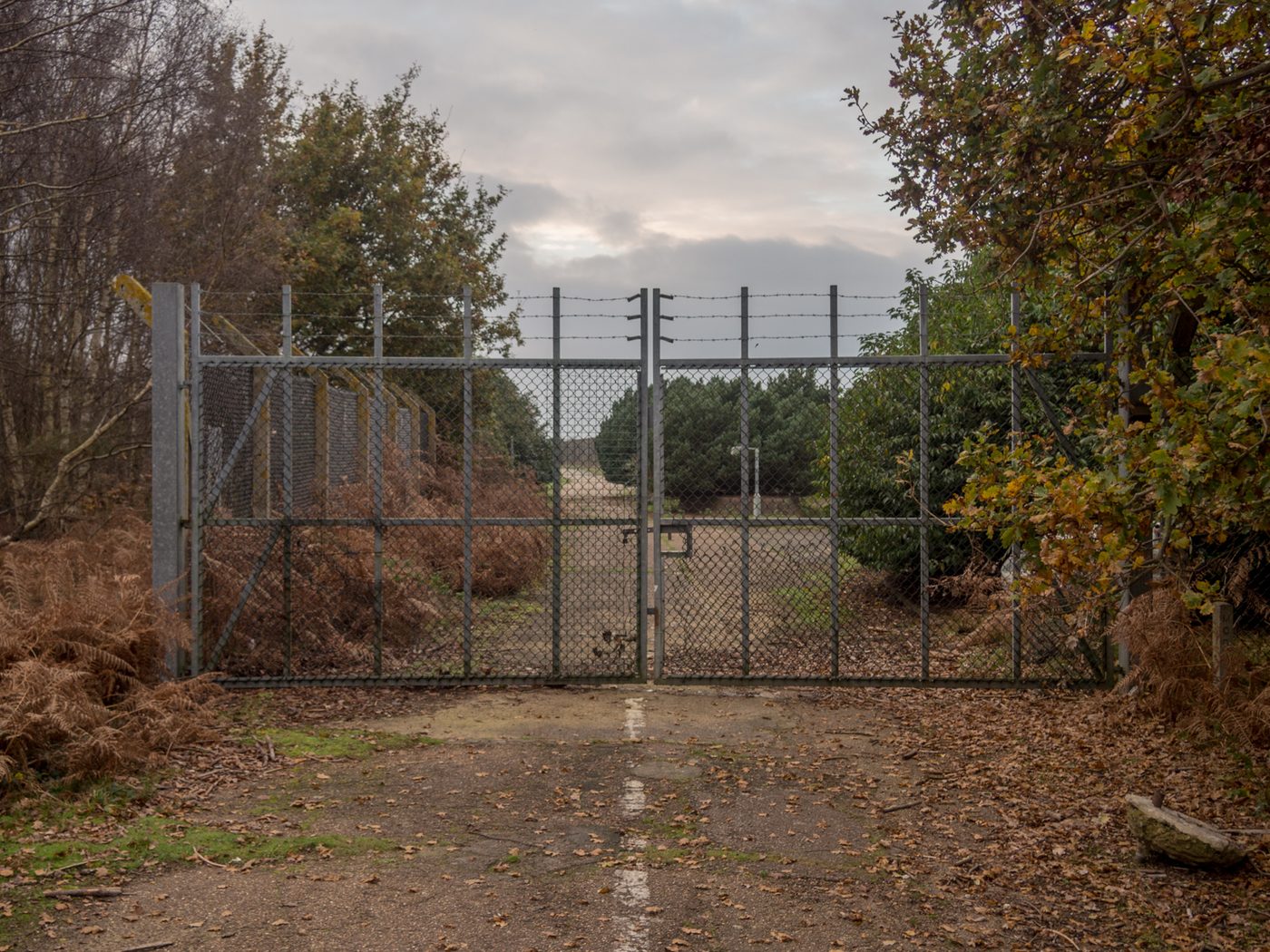
The East Gate at RAF Woodbridge, Suffolk, the gate nearest Rendlesham Forest where the first lights were reported
Photo: Taras Young via Wikimedia Commons, CC BY-SA 4.0. RAF Woodbridge's East Gate, the closest point on the perimeter fence to the forest where the sightings began.
A Fairchild A-10A Thunderbolt II of the 81st Tactical Fighter Wing, the USAF unit stationed at RAF Woodbridge and RAF Bentwaters in December 1980
Photo: SSgt. David S. Nolan, USAF, Public Domain. An 81st Tactical Fighter Wing A-10A, the unit stationed at Woodbridge and Bentwaters at the time of the incident, photographed in 1987.
Part Two

Night One

Early in the morning of December 26, 1980, roughly around 3:00am local time, two USAF security patrolmen at Woodbridge's East Gate saw unusual lights descending into the forest beyond the fence.

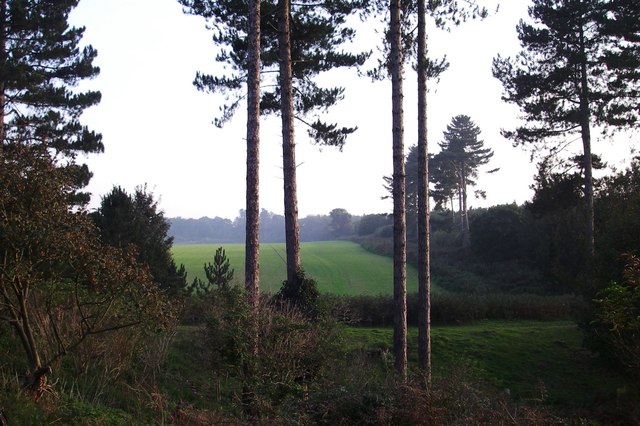
Rows of pine trees in Rendlesham Forest, Suffolk, England, the plantation forest where the December 1980 sightings took place
Photo: Burgess Von Thunen via Wikimedia Commons, CC BY-SA 2.0. The close-planted pine rows of Rendlesham Forest, largely unchanged in character since 1980.

Thinking an aircraft might have crashed or been forced down, the patrolmen radioed for permission to go outside the perimeter fence and investigate on foot. The on-duty flight chief agreed, and three security policemen, Airman First Class John Burroughs, Airman Ed Cabansag and Staff Sergeant Jim Penniston, headed into the trees toward the lights. What they found there, according to statements recorded within days of the event, is the single most-quoted part of the entire case: a glowing, metallic, triangular object sitting in a forest clearing, roughly two to three meters across its base.

Coincidentally, and this matters: an exceptionally bright meteor, the kind astronomers call a fireball, was independently recorded by observers across southern England at almost exactly the same time that morning, roughly 2:50am UTC. It is entirely plausible that a silent, brilliant streak of light burning up in the atmosphere is what first sent patrolmen out expecting to find a downed aircraft, primed to interpret anything unfamiliar they then found in the dark forest as connected to it.

The individuals reported seeing a strange glowing object in the forest. The object was described as being metallic in appearance and triangular in shape… It illuminated the entire forest with a white light. The object itself had a pulsing red light on top and a bank(s) of blue lights underneath.

— Lt Col Charles Halt, memorandum to the UK Ministry of Defence, January 13, 1981

As the patrolmen approached, the object maneuvered through the trees and disappeared. Animals on a nearby farm, per Halt's later memo, “went into a frenzy” at the same moment. It was briefly sighted again near the back gate roughly an hour later, and then the night ended. Nothing about it yet involved Halt, whose own investigation was still two nights away.

Part Three

The Craft

Every detailed description of the object itself comes from that first night, from the three security patrolmen who walked into the forest and, by Staff Sergeant Jim Penniston's account, got closer to it than anyone else ever would.

The Contemporaneous Description

Triangular, Metallic, On Legs

Halt's memo, drawing on the patrolmen's statements, describes an object roughly two to three meters across its base and about two meters high, metallic in appearance, illuminating the entire forest in white light, with a pulsing red light on top and a bank of blue lights underneath. It appeared to be either hovering or resting on legs. Forester Vince Thurkettle, who interviewed Penniston separately, has noted Penniston also described it elsewhere as roughly “the size of a tank,” a rough estimate rather than a precise measurement.

Penniston's Expanded Account

A Warm Surface, And Symbols

Penniston has said he approached the object alone and touched its surface with his bare hand, describing it as warm, smooth and metallic, unlike anything built by any air force he recognized. In interviews and written accounts given in the years and decades after 1980, he has also described noticing raised, glyph-like symbols on the object's surface and sketching them in his notebook at the time.

A note on Penniston's later claims: Penniston's most elaborate assertions, that he later recovered or “downloaded” a binary code sequence from the object corresponding to specific coordinates, do not appear in his original 1980 written statement and emerged only in interviews and affidavits given many years afterward. They are disputed even among researchers otherwise sympathetic to the case, and we present them here as later additions to his account rather than as contemporaneous, documented fact.

What's harder to dispute is the underlying shape of the story: a trained security patrol, sent to investigate what they believed was a downed aircraft, instead filed a same-week report describing an object that maneuvered through dense forest and vanished, a description Halt considered credible enough to put his own name and rank to in an official memorandum weeks later.

Part Four

Night Two

On the evening of Saturday, December 27, Lieutenant Colonel Charles Halt was at an officers' dinner at RAF Woodbridge when Lieutenant Bruce Englund came in and said four words that ended his evening: “The UFO is back.”

Lt Col Charles I. Halt

Deputy Base Commander, RAF Woodbridge

He went out to see for himself, and came back with a tape recording nobody has ever fully explained.

A group of servicemen had reportedly seen unexplained lights in the forest again. Halt returned to his quarters at RAF Bentwaters, changed, and joined the group out in the forest sometime after midnight, now in the early hours of December 28. Unlike the freelance patrol two nights earlier, this was Halt's own decision, made as the base's second-highest-ranking officer, to go and document whatever was happening himself.

He brought with him a handheld Lanier micro-cassette recorder, the same kind he carried day to day for note-taking, and switched it on. Alongside him were Englund, who guided him toward the site and later toward the lights; Sergeant Monroe Nevels, a Chemical Defense Instructor operating a geiger counter he wasn't a specialist in; Sergeant Bobby Ball; and several other airmen. The investigation's first stop was the three ground depressions found the previous morning, at the spot where the object had reportedly stood two nights before.

Part Five

The Halt Tape

What Halt recorded that night runs 18 minutes and 12 seconds, though it covers activity spanning several hours; he clicked the recorder on and off constantly to conserve tape. It has become the single most examined piece of audio in UAP history, because unlike almost every other famous case, this one comes with a real-time recording of a trained military officer's own reactions as events unfolded around him.

~01:00–01:50 — Halt, Nevels and Englund work the geiger counter and a Starlight infrared scope across the three ground depressions and nearby pine trees, calling out readings and comparing notes on abrasions found on several tree trunks, all facing the same direction, toward the center of the suspected landing site.
~01:48 — Halt notes on tape that they're “hearing very strange sounds out of the farmer's barnyard animals,” describing them as very active. The neighboring farm was, in fact, an arable operation with no livestock; researchers have since suggested the sounds more likely came from muntjac deer in the forest itself.
~02:00 — Crossing open fields away from the depressions, the team spots a strange flashing light in the distance. What follows is the tape's most quoted stretch.

It's coming this way. It is definitely coming this way.
Pieces of it are shooting off.
There is no doubt about it. This is weird!

— Lt Col Charles Halt, tape recording, December 28, 1980, ~02:00 local time
~02:30–03:30 — Halt describes the light through the Starlight scope as looking “like an eye winking at you,” then reports two additional star-like objects to the north and one to the south, all maneuvering with red, green and blue lights. At one point: “Now we're observing what appears to be a beam coming down to the ground.” He calls the base command post and asks them to contact RAF Watton for a radar check; Watton later reports seeing nothing on radar at the time.
04:00 — Halt's final log entry: one object still hovering over Woodbridge base, five to ten degrees off the horizon, “still moving erratic and similar lights and beaming down as earlier.” The tape ends shortly after.

The tape itself sat forgotten for months. Colonel Sam Morgan, who took over as base commander roughly six months later, found it in a desk drawer and, after speaking with Halt and the UK base commander, released copies to UFO researchers in 1984; the recording didn't reach wider circulation until 1985. Morgan's own summary of the whole affair, given to an American researcher that year, was blunter than anything on the tape itself: he called it “just a bunch of guys screwing around in the woods.”

Part Six

The Markings

The morning after the first sighting, personnel returned to the reported site and found three depressions in the ground, roughly forming a triangle, along with damage to several nearby pine trees.

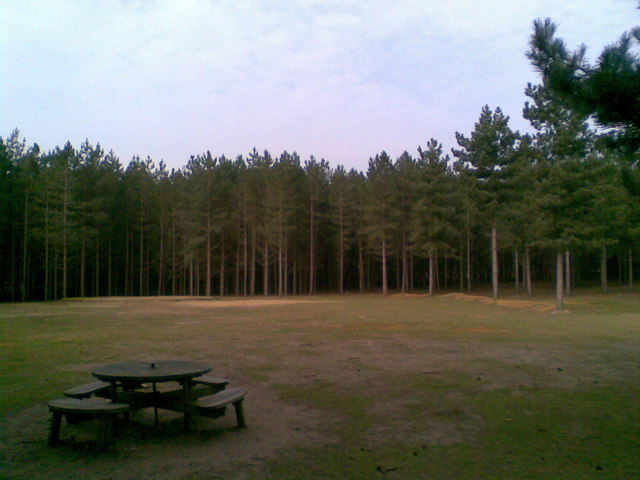
The supposed UFO landing site in Rendlesham Forest, Suffolk, where three ground depressions were found in December 1980
Photo: Simon Leatherdale via Wikimedia Commons, CC BY-SA 2.0. The clearing in Rendlesham Forest identified as the reported landing site.

Per Halt's memo, the three depressions measured about 1.5 inches deep and 7 inches in diameter. On the night of the second investigation, the team checked the area with a geiger counter and recorded beta/gamma readings of 0.1 milliroentgens, with peak readings inside the depressions and near the center of the triangle they formed; a nearby tree showed moderate readings, 0.05 to 0.07, on the side facing the site. Both figures sit only modestly above normal background radiation, and independent analysis of Sergeant Nevels' actual click-rate calls on the tape itself suggests results closer to ordinary background fluctuation than to a clearly anomalous source.

The Military Account

Depressions, Abrasions, A Twisted Impression

On the tape, Halt describes the ground marks as looking “like something twisted as it dropped… like someone took something and sat it down and twisted it from side to side,” and notes multiple nearby pine trees with fresh abrasions, all facing the center of the site, with sap that had “come out that fast,” unusually quickly for old damage.

The Civilian Forensic Account

Rabbit Diggings And Forester's Axe Marks

Suffolk police, called to the scene, attributed the depressions to animal activity. Local forester Vince Thurkettle, who examined the site independently in 1983 after the trees around it had been felled, identified the depressions as rabbit diggings several months old, irregular and asymmetrical, layered with fallen pine needles, in an area planted with trees only 10 to 15 feet apart, hardly room to land a craft the size described. He identified the “burn marks” as ordinary axe cuts foresters make to mark trees for felling, with pine resin bubbling into the cut in a way that can resemble scorching.

Part Seven

The Aftermath

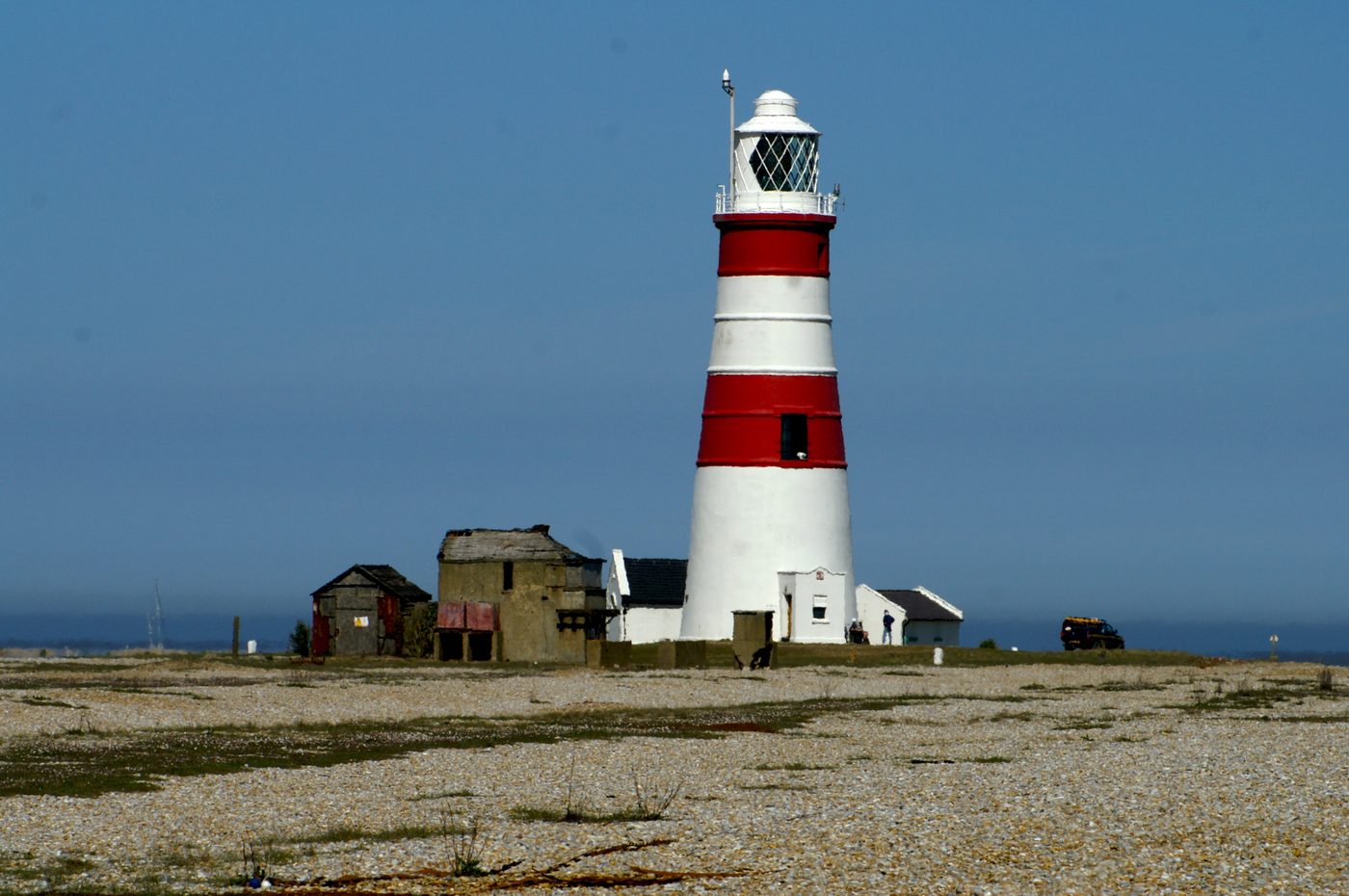
Suffolk Constabulary was called to the site by the USAF and reported seeing no craft, only the Orford Ness Lighthouse, five miles east on the Suffolk coast. Beyond that, for more than two years, almost nothing happened.

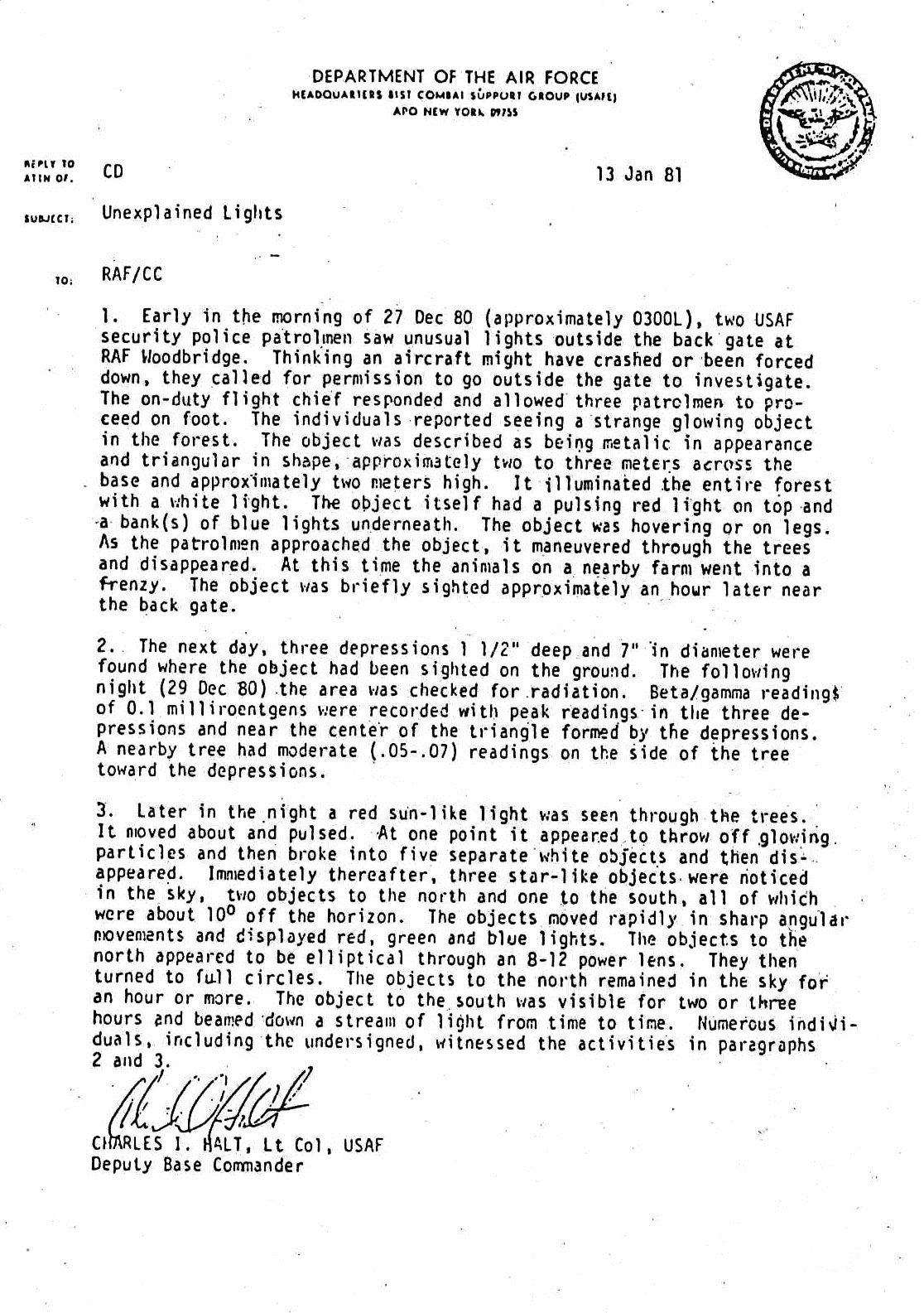
The declassified 'Unexplained Lights' memorandum written by Lt Col Charles Halt to the UK Ministry of Defence, dated January 13, 1981
Lt Col Charles Halt, Public Domain, via Wikimedia Commons. The “Unexplained Lights” memorandum, dated January 13, 1981, held today at the UK National Archives, Kew.

On January 13, 1981, more than two weeks after the events described, Halt wrote a two-paragraph memo titled “Unexplained Lights” to the UK Ministry of Defence, on plain USAF letterhead, unclassified. It summarized both nights in flat military language: the triangular object, the depressions, the radiation readings, the later star-like lights beaming down “a stream of light from time to time.” It was, by design, a routine notification, not an alarm.

The memo then did almost nothing for over two years. The USAF's own copy was apparently discarded as being of no further interest; when a Freedom of Information request eventually surfaced it in June 1983, the Air Force had to request a replacement copy from the British Ministry of Defence, which had kept its own. The original is held today at the UK National Archives in Kew, filed under DEFE 24/1948.

A note on the dates: Halt's memo, written from memory more than two weeks after the events, states the first sighting occurred on “27 Dec 80” and the radiation survey on the night of “29 Dec 80.” Subsequent research, cross-referencing witness statements, police logs and the independently timed fireball meteor, has established both dates are off by exactly one day: the first sighting was the early morning of December 26, and Halt's own investigation took place the following night, in the early hours of December 28. We've used the corrected dates throughout this case file.

Researcher David Clarke's 2010 interviews with the officials involved, Halt's superior Colonel Sam Morgan, UK base commander Donald Moreland, and Ministry of Defence UFO-desk officer Simon Weeden, found that the MoD's own review of the memo was cursory at best: no witnesses were ever formally interviewed, and the matter was closed with the standard finding that it “posed no threat to national security,” and was therefore never investigated as a security matter at all.

Part Eight

The Cover-Up?

The case stayed almost entirely private for nearly three years. What broke it into public view wasn't a leak from within the Air Force or the Ministry of Defence: it was a tabloid checkbook.

October 1983

“UFO Lands In Suffolk — And That's Official”

The News of the World ran the story under that headline, sourced to a former airman given the pseudonym “Art Wallace,” who claimed his life had been threatened if he talked, while simultaneously giving interviews to newspapers and television. He was later identified as Larry Warren. The paper reportedly paid £12,000 for the story.

A Disputed Witness

Larry Warren's Expanded Story

Warren was not one of the three documented patrolmen from the first night, and his later, far more dramatic public claims, of larger craft, recovered occupants and an active government cover-up, are not corroborated by Halt, Penniston or Burroughs, and are treated skeptically even by researchers otherwise sympathetic to the case.

1984

“Sky Crash”

A book by Brenda Butler, Jenny Randles and Dot Street framed the case as “the world's first officially observed, and officially confirmed, UFO landing and contact,” cementing the story's public shape for a generation of readers, well before the Halt tape itself was widely available to check the claims against.

What The Record Actually Shows

Neglect, Not Necessarily Conspiracy

No document has ever surfaced showing a deliberate government cover-up. What the declassified record actually shows is a memo that sat unread for two years, a military command that judged the matter closed without interviewing a single witness, and a tabloid payday that arrived years later and reshaped the story for public consumption before most of the primary evidence was even public.

Whether that institutional shrug amounts to its own kind of cover-up, or simply reflects how low a priority the MoD genuinely placed on the case, is a judgment call the declassified paper trail leaves open. Halt himself has continued, across decades of interviews, to say he doesn't believe the full picture was ever properly investigated by anyone, on either side of the Atlantic.

Part Nine

What They Saw

The case's most credible skeptical explanation didn't come from the military or the government. It came from a science journalist with a map and a flashlight.

Orford Ness Lighthouse on the Suffolk coast, identified by researcher Ian Ridpath as the likely source of the flashing light described by Lt Col Halt
Photo: David Merrett via Wikimedia Commons, CC BY 2.0. Orford Ness Lighthouse, roughly five miles east of Rendlesham Forest on the Suffolk coast.

In 1983, astronomy writer Ian Ridpath visited the forest with local forester Vince Thurkettle, who told him bluntly: “It's the lighthouse.” Thurkettle plotted the direction the airmen described on a map and found it pointed straight at Orford Ness Lighthouse, five miles away on the coast. Standing at forest's edge after dark, Ridpath found the lighthouse beam did appear to hover just above ground level, brilliant and close-seeming through the trees, exactly because Rendlesham Forest sits higher than the coastline. A BBC television crew filmed the effect for Breakfast Time in 1983; Ridpath published the full explanation in The Guardian on January 5, 1985.

His close analysis of the Halt tape itself adds a specific, testable detail: the gap between Englund's “there it is again… there it is” is almost exactly five seconds, matching Orford Ness's known flash interval. At one point on the tape, a voice, not Halt's, corrects him that the light is “yellow,” not the red he insists on describing, a small inconsistency researchers have flagged as evidence of a mundane, misidentified light source rather than a single controlled craft.

I don't know of anyone around here who believes that anything strange happened that night… It's the lighthouse.

— Vince Thurkettle, Rendlesham forester, quoted by Ian Ridpath, 1983

The lighthouse explanation accounts well for the extended sky-watching stretch of Halt's own tape: a fixed, flashing coastal light seen through trees, at night, by a team already primed to expect something extraordinary. It accounts far less comfortably for the first night's report, patrolmen describing a defined, low, metallic object that maneuvered through the trees at close range and disappeared, something a five-mile-distant fixed lighthouse simply cannot do. Halt has never fully accepted the lighthouse as the whole answer, and continues, into the present day, to maintain that the earlier, closer encounter remains genuinely unexplained.

Verification

Sources

Every fact in this case file was cross-referenced against at least two independent sources, anchored by the declassified Halt memo, the UK National Archives and Ian Ridpath's transcript of the Halt tape itself. All links open in a new tab.

UK National Archives Digitised MoD File DEFE 24/1948: UFO Reports Of Sighting, Rendlesham Forest, December 1980

The official Ministry of Defence file, including Halt's memo, held at the National Archives, Kew.

UK National Archives Research Guide: UFOs

The National Archives' own guide to its declassified UFO files, including the Rendlesham case and the wider 2008–2013 MoD file release programme.

Primary Document The Halt Memo, January 13, 1981 (original scan, PDF)

A digitized scan of Halt's original “Unexplained Lights” memorandum to the Ministry of Defence.

Document Archive The Black Vault: The Halt Memo — The Rendlesham Forest Incident

Archived context and further declassified documents related to the memo's release.

Tape Transcript & Analysis Ian Ridpath: Transcript Of Col Halt's Tape

A word-for-word transcript of the full 18-minute Halt tape, reviewed and clarified with Halt's own input, by the science journalist who first proposed the lighthouse explanation.

Original Investigative Article Ian Ridpath: “A Flashlight In The Forest” (The Guardian, January 5, 1985)

The original newspaper article that first proposed and demonstrated the Orford Ness Lighthouse explanation, reproduced with additional context.

BBC News BBC News: Rendlesham Forest UFO — Are We Any Closer To The Truth 40 Years On?

A 40th-anniversary retrospective, including academic David Clarke's assessment of the case's current, unresolved status.

Academic Research Dr David Clarke: Top 10 UFO Documents At The National Archives

Analysis from the academic and former National Archives UFO consultant who conducted the definitive interviews with the MoD officials who handled Halt's memo.

Secondary Reference Wikipedia: Rendlesham Forest Incident

Used as a secondary cross-reference for names, dates and the sequence of events; every fact drawn from it was checked against a primary or independent source above.

A note on this case file's sourcing: Where military testimony (Halt's memo and tape) and civilian forensic explanation (the lighthouse, the fireball, the rabbit diggings) genuinely conflict, we've presented both rather than declaring a winner. We don't claim to know what happened in Rendlesham Forest in December 1980. We've reported what the declassified record, and the people who were there, actually said.

JOIN THE DISCUSSION